
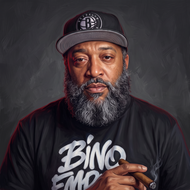

The Men of Halloween, The 761st Black Panthers- Inducted into George S Patton's own 3rd Army, October 31, 1944. A day that lives IN HONOR. THE REAL BLACK PANTHERS.
The American military in World War II was a landscape of stark contradictions, a segregationist institution fighting a global war against fascism. At the intersection of this irony stood General George S. Patton Jr.—a man whose soul was anchored in the Confederacy, whose family fought under Robert E. Lee, and who harbored deep-seated, viral racial prejudices against Black men. Yet, driven by a ruthless, pragmatic obsession with winning, Patton made a decision that would inadvertently ignite the fuse of modern civil rights. By unleashing the 761st Tank Battalion, the "Black Panthers," onto the European theater, Patton was forced to let Foundational Black Americans (FBAs) prove their lethal efficiency on the battlefield.
This essay explores the battlefield synergy between a prejudiced Confederate scion and the elite Black tankers who forced the hand of history, providing a tailored perspective for on how raw combat merit dismantled institutional lies.
I. The Ghost of Lee and the Viral Prejudice of Patton
To understand the weight of Patton’s interaction with the 761st, one must understand his psychological and familial makeup. Patton did not just happen to be from the South; he was a walking monument to the "Lost Cause" of the Confederacy. His grandfather, Colonel George S. Patton Sr., commanded the 22nd Virginia Infantry under Robert E. Lee and died for the Confederate cause at the Battle of Winchester. His great-uncle, Waller T. Patton, was mortally wounded during Pickett’s Charge at Gettysburg. Patton grew up with portraits of Lee and Stonewall Jackson hanging in his home like religious icons. He was personally mentored in horsemanship and cavalry tactics by John Singleton Mosby, Lee’s legendary guerrilla "Gray Ghost."
Patton’s views on race were a direct reflection of this lineage. He held viral, deeply entrenched prejudices against Black men, viewing them through a paternalistic, white supremacist lens. He did not believe Black men possessed the psychological fortitude, intelligence, or inherent bravery required for high-level mechanical and armored warfare.
When the War Department, facing intense pressure from FBA civil rights leaders at home, began training all-Black combat units like the 761st Tank Battalion at Camp Claiborne, Patton was deeply skeptical. To him, the military experiment of putting Black men behind the controls of 30-ton Sherman tanks was a political stunt destined for failure.
II. The Crucible of Necessity: "Who Asked for Color?"
By late 1944, the reality of the European theater shattered Patton’s aristocratic theories. The Third Army’s rapid, aggressive push across France had drained his infantry and depleted his armored divisions. Patton was a commander obsessed with momentum; stalling meant failure, and failure was a sin Patton could not tolerate.
When the War Department offered him the 761st Tank Battalion, Patton faced a profound internal conflict. Accepting them meant betraying his viral racial beliefs and the segregationist ideals of his Confederate ancestors. Rejecting them meant starving his front lines of vital armor. Patton’s ultimate religion was victory. Pragmatism overrode prejudice. When questioned about the optics of bringing an all-Black combat unit into his beloved Third Army, Patton famously snapped: "Who asked for color? I asked for tankers."
On October 31, 1944, Patton stood before the men of the 761st at Belfort, France. He delivered a speech that sounded remarkably progressive on the surface, designed to fire up his new weapon:
"Men, you're the first Negro tankers to ever fight in the American Army. I would never have asked for you if you weren't good. I have nothing but the best in my Army. I don't care what color you are as long as you go up there and kill those Kraut sons of bitches."
Yet, the duality of the man was exposed hours later. Returning to his trailer, Patton penned a private diary entry that revealed his unchanged, viral beliefs: "They gave a very good impression, but I have no faith in the inherent fighting ability of the race." He wanted them to fight, but his prejudice predicted they would break.
III. The Black Panthers Shatter the Lie
The men of the 761st knew exactly what they were up against. They were fighting a two-front war: one against the Nazi war machine, and another against the low expectations of their own commanders. Under the motto "Come Out Fighting," these Foundational Black American men entered combat on November 7, 1944.
What followed was 183 days of continuous, unrelenting frontline combat. The 761st became Patton’s iron tip of the spear. They spearheaded assaults through northern France, smashed through the Siegfried Line, and fought brutally through the frozen hell of the Battle of the Bulge to rescue trapped elements of the 101st Airborne at Bastogne.
The battlefield became an equalizer that Patton’s prejudices could not rationalize away. Black men were not breaking; they were out-fighting their white counterparts.
• Staff Sergeant Ruben Rivers: During a fierce engagement at Guebling, France, Rivers’ tank hit a mine, shattering his leg to the bone. He refused morphine and refused to evacuate. For three days, he commanded a replacement tank, directing fire against German positions until a German high-explosive round directly struck his turret, killing him. His actions saved his company and earned him a posthumous Medal of Honor.
• Sergeant Warren G.H. Crecy: Known as the "Iron Man" of the 761st, Crecy’s tank was destroyed through a direct hit. Undeterred, he dismounted under heavy machine-gun fire, climbed aboard a crippled vehicle, and used its .50-caliber machine gun to wipe out the enemy positions that had pinned down his infantry. When that gun jammed, he extracted another weapon and kept fighting.
IV. The Dining Hall Incident: Earned Respect Overrides Caste
As the 761st piled up bodies and victories, Patton's viral prejudice began to fracture under the sheer weight of reality. The ultimate proof of this internal shift manifested not in an official military dispatch, but in a military dining hall.
Janitor lines and supply routes were the standard, but the 761st forced their way into the room where policy was written with blood. During the European campaign, a white mess officer refused to seat the battle-worn Black men of the 761st inside the main dining hall, attempting to force them to eat outside or in segregated quarters. When Patton caught wind of this insult to his frontline soldiers, he was furious. He did not act out of modern progressive enlightenment, but out of an unyielding warrior ethos: these men had spilled blood for his Third Army, and they had earned their place at the table.
Patton personally intervened, storming into the mess facility and overriding his own officers. He ordered the staff to seat the FBA tankers inside with the rest of the troops immediately. By forcing white officers and soldiers to eat alongside Black men, Patton violated the very social caste system his Confederate grandfather had died to protect. The Black Panthers did not plead for acceptance; their undisputed competence on the battlefield extracted an unprecedented level of respect from one of the most prejudiced commanders in American history.
V. The Generational Truth: The Blueprint for Civil Rights; its not a Boomer thing.
This hard-won respect reveals a critical truth that flips the mainstream narrative of the Civil Rights movement on its head. Modern media often frames civil rights as a late-1960s Baby Boomer cause célèbre, dominated by collegiate protests and counter-culture hippies. The reality is far more rugged. Civil rights was a fight built, funded, and fought by the World War II generation and the early Silent Generation; Ergo this, the Navajo Code Talkers, The Red Tails and in 1946 the Battle of Athens, Tennessee.
The true foundation of the movement was laid twenty years before the late-60s counter-culture ever picked up a picket sign. It was driven by FBA men who had looked death in the face, crushed the armies of Europe, and returned home completely unwilling to accept second-class citizenship.
• The Blood-Bought Receipt: The undeniable data produced by the 761st under Patton's command landed directly on the desk of President Harry S. Truman. When Truman signed Executive Order 9981 in 1948, formally desegregating the United States Armed Forces, he did so using the leverage these veterans provided.
• The Veteran Leadership: The legal battles, the early boycotts, and the organized resistance of the 1950s and early 1960s were engineered by battle-hardened World War II veterans. They possessed the logistical training, tactical discipline, and psychological resilience acquired in places like the Ardennes and France.
By the time the late 1960s arrived, the legal backbone of segregation had already been broken by the blood, sweat, and strategic brilliance of the WWII and Silent generations. The Boomers inherited a movement that was already won at the structural level by men who had already proven their peerless worth in blood.
VI. Conclusion: The Irony of the Warrior Class
The story of Patton and the 761st is a masterclass in historical irony. A general who romanticized his Confederate lineage, who idolized Robert E. Lee, and who privately doubted the basic capabilities of Black men, became the very catalyst who unleashed them to prove their ultimate worth.
Patton’s viral beliefs told him one thing, but his eyes told him another. The Black Panthers did not need Patton to love them, and they did not need him to be a progressive ally. They needed the platform and the ammunition. Through their sacrifice, these Foundational Black American men shattered the grand illusion of white military superiority. They forced a prejudiced Confederate lineage WW2 general to ride their tanks to glory, engineering the opening salvo of the modern struggle for true civil rights through pure, undeniable military excellence.
VII. A Call to Action for the Locals: Honor the Real Men
This history isn't just something to read; it’s a lineage we are duty-bound to remember. Angryman lives this standard himself, leading by example with his own family to ensure these giants are never forgotten. It would be incredibly powerful if Angryman himself led the charge on this by filming a short, ten-to-fifteen-minute feature directly from a graveyard. This Halloween, the community should follow that playbook: no matter what the weather is outside, take your family, go out to a local or national cemetery, and search for the quiet corners where our history rests. Walk those rows, look at the headstones, and find the graves of what may be the Black men who fought in World War II or Korea.
Stand there in the stillness, let the armor drop, and let the tears come. Do not just speak vaguely to their memory—look directly at the headstone, look directly at those etched lines, and talk to that man as if across the dinner table. Speak to him as you would to a brother, a father, or a trusted friend. Say your thank you directly to him: "Thank you, from America, for saving our nation, and for being real men." Make your Halloween a true, unyielding celebration of the "Real Black Panthers." True legacy isn't given by the system; it is kept alive by the living who refuse to let the sacrifices of the warrior class fade from memory.
I DECLARE THIS CALENDAR DAY RENAMED, FROM HENCEFORTH IN THE BINO NATION THIS IS NO LONGER HALLOWEEN, THIS IS BLACK PANTHERS DAY.

In this video, The Angryman shares why he's excited to be part of the Locals community. He talks about how Locals provides a platform for creators to connect with their audience and build a community based on shared interests and values. The Angryman emphasizes the importance of free speech and the ability to express one's opinions without fear of censorship, which is why he feels Locals is the perfect fit for him and his followers.
He also discusses how being on Locals allows him to have more control over his content and how it's presented, as opposed to being at the mercy of algorithms and constantly changing social media policies. The Angryman believes that Locals offers a more sustainable model for content creators, allowing them to focus on creating high-quality content for their audience.
Throughout the video, The Angryman encourages viewers to join him on Locals and be a part of the community. He shares the benefits of membership, such as exclusive content, early access to ...
Let me explain something to the slow fucks in the back.
We live in a Federal Representative Republic. We do not live in a Democracy.
Lets look at Democracies..
DPRK
Democratic People's Republic of Korea. NORTH KOREA.
German Democratic Republic- FORMER EAST GERMANY
Did the Soviet union call itself a democracy?
Yes, the Soviet Union explicitly and continuously called itself a democracy. However, its leadership rejected Western "bourgeois" or liberal democracy, claiming instead that the USSR practiced a superior, authentic form of governance known as "socialist democracy" or "Soviet democracy."
The Soviet concept of democracy differed fundamentally from Western models in several key ways
• Joseph Stalin famously claimed that the 1936 Soviet Constitution made the USSR "the most democratic country in the world."
• Article 9 of the 1977 Brezhnev Constitution explicitly stated that the primary direction of the Soviet political system was the "extension of socialist democracy," which it defined as the ...


